
Mark-0 COVID Heterogeneous-Agent ABM#
Mark-0 is a closed-economy ABM with \(N\) firms, one representative household, one commercial bank, and one central bank. The COVID extension [] adds the parameter set used to study V-, U-, L-, and W-shaped recovery regimes. Each macro period executes an ordered 24-phase loop: price/wage adjustment, hiring/firing, production, household consumption, interest-rate setting, bankruptcy, and firm revival.
Stochastic phases are reparameterised through three independent
frozen \(U(0, 1)\) noise buffers of shape (timesteps, N_firms)
pre-drawn in initialize(). Boundary conditions on the two
gradient-critical paths (stay_alive indicator and the positive-\(Y\)
guard) use Behavior.diffwhere; all other branches use plain
torch.where, matching the abmstat reference pattern.
Module Contents#
Mark0COVID is divided into Variables, Parameters (fixed constants), Scenarios, and the Behavior (model initialization and steps). See the sibling pages linked from the model index for the per-component tables.
Implementation in MacroStat#
The forward pass is differentiable end-to-end. The 24-phase loop is
decomposed into named methods on BehaviorMark0COVID so that each
phase carries its own docstring and Equations section.
ParametersMark0COVID.get_default_hyperparameters sets
dtype = torch.float64 to match the abmstat reference precision.
Model Dynamics#
Preparatory Steps#
%load_ext autoreload
%autoreload 2

import importlib
import logging
import sys

from matplotlib import pyplot as plt

from macrostat.models.Mark0COVID import Mark0COVID, ParametersMark0COVID

plt.style.use("../../macrostat.mplstyle")
importlib.reload(logging)
logging.basicConfig(stream=sys.stdout, level=logging.INFO)
Four Gualdi phases#
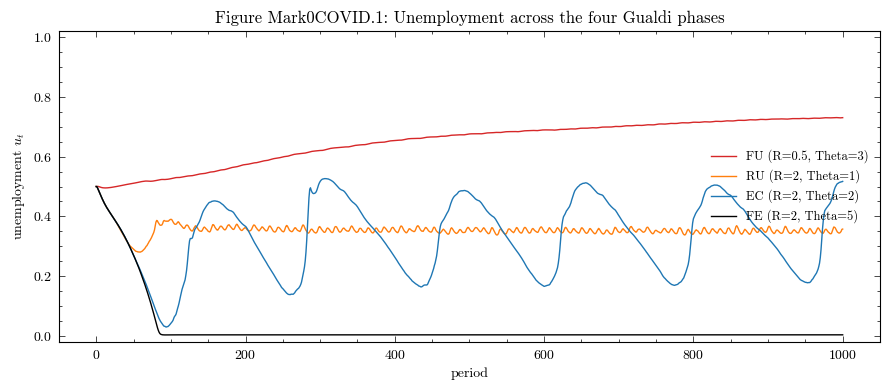
show that the Mark-0 long-run regime is determined by the location of \((R, \Theta)\) in the parameter plane, where \(R = \eta_+/\eta_-\) is the hiring/firing asymmetry and \(\Theta\) is the bankruptcy default threshold. Four phases occupy distinct regions:
FU (Full Unemployment): \(R < R_c\), the economy collapses to near-zero employment regardless of \(\Theta\).
RU (Residual Unemployment): \(R > R_c\), low \(\Theta\); firms default quickly so a non-trivial unemployment rate persists.
EC (Endogenous Crises): \(R > R_c\), intermediate \(\Theta\); bankruptcy cascades trigger large oscillations between near-FE and near-FU regimes.
FE (Full Employment): \(R > R_c\), large \(\Theta\); defaults are rare and the economy sits near full employment.
Each phase is realised as a distinct ParametersMark0COVID
instance varying HiringFiringRate (\(R\)) and DefaultThreshold
(\(\Theta\)) only; all other parameters take their default values.
phases = {
    "FU (R=0.5, Theta=3)": (0.5, 3.0),
    "RU (R=2, Theta=0.5)": (2.0, 0.5),
    "EC (R=2, Theta=1.2)": (2.0, 1.2),
    "FE (R=2, Theta=5)": (2.0, 5.0),
}

paths = {}
for label, (R, Theta) in phases.items():
    params = ParametersMark0COVID(
        hyperparameters={"timesteps": 1000, "N_firms": 10000, "seed": 0},
    )
    params["HiringFiringRate"] = R
    params["DefaultThreshold"] = Theta
    model = Mark0COVID(parameters=params)
    model.simulate()
    paths[label] = model.variables.to_pandas()
Unemployment trajectory#
The aggregate unemployment series isolates the four phases at a glance. FU collapses to \(u \to 1\); RU settles at a positive residual; EC oscillates between near-FE and near-FU bands; FE converges close to full employment.
fig, ax = plt.subplots(figsize=(9, 4))
colors = ["tab:red", "tab:orange", "tab:blue", "k"]

for color, (label, df) in zip(colors, paths.items()):
    ax.plot(df.index, df["Unemployment"], color=color, linewidth=1.0, label=label)

ax.set_title("Figure Mark0COVID.1: Unemployment across the four Gualdi phases")
ax.set_xlabel("period")
ax.set_ylabel(r"unemployment $u_t$")
ax.set_ylim(-0.02, 1.02)
ax.legend(loc="center right", frameon=False, fontsize=9)
plt.tight_layout()
plt.show()
Notes#
The shape of every het-agent state tensor in
model.variables.timeseriesis(T + 1, N_firms); aggregates are stored as(T + 1, 1).to_pandas()returns a multi-column DataFrame indexed bytime.